
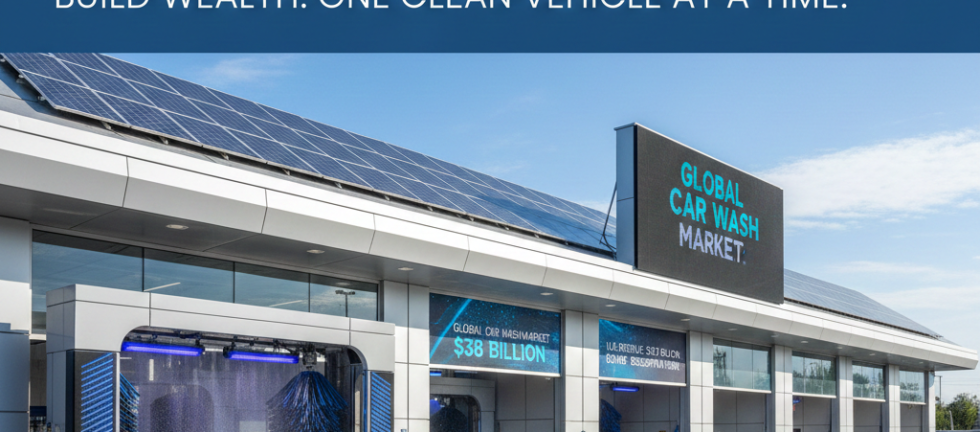
The car wash industry has quietly become one of the most dependable and rewarding entrepreneurial paths available today. While headlines chase the latest tech startup or retail trend, thousands of smart operators are building wealth one clean vehicle at a time, and the numbers behind this industry explain exactly why. The global car wash service market was valued at approximately $36 to $37 billion in 2025, with projections placing it at $37 to $38 billion through 2026 and a compound annual growth rate of around 5 to 5.5 percent expected to sustain momentum well into the early 2030s. In the United States alone, the car wash and auto detailing sector generated an estimated $20.7 billion in revenue in 2025, buoyed by subscription models, express formats, and a consumer base increasingly hungry for fast, reliable, eco-conscious cleaning options.
What makes these figures particularly compelling is their underlying stability. Unlike fashion retail, restaurant trends, or software platforms that can be disrupted overnight, the car wash industry rests on a biological certainty: vehicles get dirty, and people want them clean. Rain brings mud. Summer brings pollen and bird droppings. Winter brings road salt that eats into paint and undercarriages. Urban commutes leave a film of exhaust, grime, and pollution on every surface. And with over 1.4 billion vehicles operating worldwide, including nearly 290 million registered in the United States, the addressable market is not shrinking anytime soon. In fact, urbanization trends, rising incomes in emerging economies, and the sheer growth in vehicle ownership across Africa, Southeast Asia, and Latin America are expanding the total pool of potential customers year after year.
Perhaps most encouragingly, the shift in consumer behavior is doing the industry enormous favors. Fewer people wash their cars at home than at any point in recent history. Busy schedules, water restrictions in drought-affected regions, the absence of driveways in urban apartments, and a growing appreciation for professional results have all pushed drivers toward commercial washing at increasing rates. A professional wash not only cleans more thoroughly than a bucket-and-sponge job in the driveway, but it does so faster, with proper drainage for chemical runoff, and often with water recycling systems that are far more environmentally responsible than residential washdowns. That combination of quality, speed, and environmental responsibility is a powerful selling proposition in 2026, and it is one that an informed entrepreneur can leverage from day one.
The subscription revolution deserves special mention here because it has fundamentally rewritten the economics of the car wash business in ways that benefit operators enormously. The global subscription segment within the industry was estimated at $6 to $7 billion in 2025 and is projected to grow at compound annual rates exceeding 9 percent through the mid-2030s. This growth reflects a simple but powerful behavioral shift: time-pressed consumers increasingly prefer predictable monthly plans over transactional, pay-per-wash arrangements. An unlimited monthly membership at $20 to $50 per month lets a driver wash as often as needed without friction, while the operator collects reliable recurring revenue that smooths out seasonal dips and provides a foundation for forecasting, staffing, and investment. At mature, well-run locations, subscription income can account for 60 percent or more of total revenue, transforming what was once a highly variable cash business into something resembling a subscription software company in terms of revenue predictability. That is a remarkable structural advantage for any small business owner trying to plan, borrow, and grow.
This guide exists to give you a thorough, practical roadmap through every dimension of launching and scaling a car wash in 2026, from choosing the right operational model and finding the ideal location, to managing costs, navigating legal requirements, marketing effectively in a crowded digital landscape, overcoming the industry’s persistent challenges, and building toward long-term profitability. Whether you are a first-time entrepreneur with $15,000 and a used van, or an experienced business owner with capital to deploy into a full express tunnel, the principles here apply across the spectrum and the opportunity is real at every level of investment.
Understanding Your Options: Choosing the Right Business Model
The single most consequential decision you will make before spending a dollar is choosing which type of car wash operation to build. This choice determines your startup capital requirements, your daily operational demands, your revenue ceiling, your staffing needs, and the type of customer you will serve. Getting it right means aligning your resources, your market, and your personal strengths with a model that can actually thrive in your specific environment. Getting it wrong means pouring capital into an operation that either undershoots its market or overwhelms you with complexity you were not prepared for.
The manual or hand wash model is the most accessible entry point, particularly in markets where labor is affordable and plentiful. In this format, trained staff use pressure washers, microfiber cloths, quality soaps, and hand tools to deliver a thorough exterior and often interior clean. The personal, hands-on nature of the service creates opportunities for relationship-building and upselling that automated systems cannot replicate. A skilled attendant can notice a customer’s dirty floor mats and recommend an interior package on the spot, or suggest a protective wax treatment after noticing sun-faded paint. Startup costs for a well-equipped manual operation typically range from $5,000 to $50,000, covering tools, basic bay infrastructure, initial inventory, and early marketing. Margins on labor-intensive extras like hand waxing, engine cleaning, and interior sanitization can be extremely attractive. The primary vulnerabilities are weather dependency and the inherent ceiling on throughput when you are relying on human hands rather than machinery. Even so, in a high-density neighborhood, near a transport hub, or in a market where customers deeply value attentive personal service, a hand wash business can generate substantial income with very modest initial investment.
The mobile car wash model inverts the traditional equation entirely by bringing the service to the customer rather than waiting for customers to come to you. Equipped with a purpose-built van carrying a water tank, portable pressure washer, generator, eco-friendly chemicals, and all necessary tools, a mobile operator can serve homes, office parking lots, corporate campuses, apartment complexes, and fleet operators wherever vehicles happen to be sitting idle. The elimination of rent overhead is a significant financial advantage, and startup costs typically range from $10,000 to $50,000 depending on whether you purchase a new or used vehicle and how comprehensively you equip it. The model is particularly well-suited to premium market segments, because executives, fleet managers, and busy professionals will pay meaningfully more for the convenience of having their vehicles cleaned without any disruption to their schedule. Booking apps have made the logistics of managing a mobile operation far more efficient than it was even five years ago, enabling real-time scheduling, route optimization, digital payments, and customer communication from a single platform. Scaling a mobile operation requires building a fleet of vans and a team of trained operators, which introduces management complexity, but many entrepreneurs have successfully grown mobile businesses into multi-van operations serving hundreds of regular clients.
Self-service bays represent a middle path that trades the personal touch of hand washing for operational independence. In this model, customers pay to use coin-operated or app-enabled equipment, including high-pressure hoses, foam brush applicators, tire cleaners, and vacuums, to wash their own vehicles at their own pace. The operator’s role shifts from service provider to facility manager: keeping equipment maintained, the bays clean, payment systems functioning, and the overall environment safe and welcoming. Labor requirements are minimal, which enables 24-hour operation without a full-time staff presence. Investment requirements jump considerably compared to manual or mobile formats, with a 4 to 6 bay self-service facility typically requiring $100,000 to $300,000 or more to develop, including construction, drainage, and equipment installation. In 2026, integrating digital payments, contactless entry, and loyalty tracking apps into self-service bays meaningfully improves customer experience and generates useful data about usage patterns that can inform pricing and facility improvements.
Automatic and express tunnel formats sit at the top of the investment and throughput spectrum. In-bay automatic systems, where a single machine moves around a stationary vehicle, can process a car in a few minutes and handle 20 to 40 vehicles per hour at a fraction of the labor cost of a manual wash. Full express tunnel systems, where vehicles are pulled through a lengthy cleaning conveyor, can reach 60 to 100 cars per hour and are the engine behind the subscription model’s success at scale, because each membership holder can be processed quickly enough that the promised unlimited access is commercially viable. The capital requirements are substantial: in-bay automatic setups run from $200,000 to $1.2 million, while full express tunnels with land, building, and high-end systems often total $1 million to $5 million or more. But the economics at volume are compelling, and the most successful car wash chains in North America, Europe, and increasingly in Africa and Asia are built on this format. Touchless systems that use high-pressure water and chemistry rather than brushes have gained preference in 2026 as customers and operators alike recognize that contact-based systems, however gentle, carry a higher risk of minor paint damage over time.
Many of the most successful operators do not start at the top of this hierarchy. They begin with a manual or mobile operation that generates real cash flow within weeks of launch, then reinvest those earnings into equipment upgrades, additional bays, or eventually a second site. This patient, capital-efficient approach reduces risk dramatically and allows an entrepreneur to build genuine operational knowledge before deploying serious capital. The temptation to go straight to a full tunnel is understandable given the throughput numbers, but the operators who succeed most reliably tend to be those who understood their market deeply before they built their largest facility.
Location, Site Selection, and the Economics of Traffic
If you speak to experienced car wash operators about what drives long-term success more than any other single variable, most will name location without hesitation. The industry consensus, backed by decades of operational data, is that location determines somewhere between 70 and 80 percent of a car wash’s long-term revenue potential. An average operation in an excellent location will consistently outperform an excellent operation in an average location. This is not a knock on quality, service, or marketing, all of which matter enormously, but rather a recognition that car washing is fundamentally a convenience-driven, impulse-friendly transaction, and you cannot create that convenience if customers cannot easily see and access your facility.
The foundational criterion for site selection is visible daily traffic. In most markets, a location with fewer than 15,000 to 20,000 vehicles passing daily will struggle to generate the volume needed for strong profitability unless you are targeting a highly specific premium segment with very high per-unit revenue. Major arterial roads, intersections near highway on- and off-ramps, and corridors near large residential areas or commercial clusters are ideal. The critical qualifier is visibility: traffic that passes on a highway at 70 miles per hour without a clear sight line to your facility does not translate into customers the way that traffic moving at 35 to 45 miles per hour on a main commercial street does. Ease of ingress and egress matters enormously too. A location that customers have to make a difficult left turn to enter, or that is separated from the main flow of traffic by a median, will underperform its traffic count significantly.
Beyond raw traffic volume, the character of surrounding land uses shapes your customer base. Proximity to gas stations, grocery stores, big-box retailers, and other businesses that generate parking and dwell time creates natural opportunities for customers to drop a car at your facility while they complete other errands. Office parks and corporate campuses nearby mean a steady stream of vehicles that sit parked all day, perfect for mobile service appointments or for workers who stop for a wash on their lunch break. New residential developments on the edges of growing metropolitan areas represent some of the best opportunities in 2026, because they combine growing populations of vehicle-owning households with often very limited competition, since commercial car wash infrastructure tends to lag residential development by several years.
Infrastructure considerations are non-negotiable and can make or break a site that looks attractive on every other dimension. Municipal water access with adequate pressure and volume, proper drainage with sewer connections that can accommodate the chemical-laden wastewater from washing operations, reliable three-phase electrical power for larger equipment, and soil conditions suitable for the excavation required for tunnels and drainage systems all need to be verified before committing to a site. Environmental regulators in most jurisdictions now require that wash water be treated or recycled before discharge, and the infrastructure to support that compliance needs to be either present or buildable on your chosen site within a reasonable budget. Adaptive reuse of former gas stations is a particularly attractive strategy in 2026 for exactly this reason: these sites often already have fuel-era drainage infrastructure, power connections, and commercial zoning in place, and their existing visibility and accessibility from the road frequently matches the requirements of a successful car wash perfectly.
Building Your Financial Plan: Costs, Revenue, and the Path to Profitability
Entering any business without a clear, realistic financial plan is a form of optimism that the market will quickly discipline. The car wash industry rewards careful operators who understand their numbers, and punishes those who underestimate costs or overestimate volume. Building a thorough financial model before you spend your first dollar of capital is not bureaucratic box-checking; it is the difference between making informed decisions and making expensive mistakes.
On the cost side, startup expenses break down into several broad categories. Site acquisition or lease costs vary enormously by geography and format. A monthly lease for a high-traffic commercial site in a mid-size American city might run $5,000 to $15,000, while prime urban or suburban locations in major markets can exceed $20,000 per month. In emerging markets like Kenya, Nigeria, or Tanzania, lease costs may be dramatically lower, which is part of why the economics of car washing are so attractive in those environments. Site preparation and construction costs layer on top of lease: depending on whether you are building from scratch or repurposing an existing structure, these can range from $50,000 for a basic manual setup to $500,000 or more for a full tunnel build-out. Equipment represents another major line item, from entry-level pressure washers at $1,000 to $3,000 each, to in-bay automatic systems at $100,000 to $400,000, to full tunnel equipment packages that can exceed $1 million on their own.
Water management infrastructure deserves its own budget line in 2026, because it is both a regulatory requirement in most markets and a genuine competitive differentiator. Recycling systems that reclaim and treat wash water before reuse can cost $10,000 to $50,000 to install, but they reduce water consumption by 50 to 90 percent compared to single-pass systems, generating meaningful operating cost savings that compound over time while also enabling you to market your operation’s environmental credentials authentically. As water scarcity becomes an increasingly significant concern in many regions, particularly in sub-Saharan Africa, the American Southwest, and parts of Asia and Australia, the ability to demonstrate responsible water use is not just good ethics; it is a genuine business advantage.
Permits, licenses, and insurance represent costs that first-time operators frequently underestimate. Environmental permits for wastewater discharge, building permits for construction, local business licenses, zoning approvals, and specialized commercial vehicle insurance all need to be factored into your startup budget. Depending on your jurisdiction, these costs might total $5,000 for a simple mobile operation or $20,000 or more for a larger fixed facility. Workers’ compensation insurance, general liability coverage, property insurance, and garage keepers insurance (which covers customer vehicles in your care) are all essential and non-optional. Skimping on insurance in a business where customer vehicles are your responsibility is a false economy that can result in catastrophic losses from a single incident.
Working capital, the cash required to keep the business operating through its early months before revenue reaches a self-sustaining level, is one of the most consistently underestimated line items in new car wash ventures. Plan for at least three to six months of operating expenses, including rent, labor, utilities, chemicals, and loan repayments, to be available in reserve at launch. This typically equates to 20 to 30 percent of total startup investment. Many businesses that fail in their first year do so not because their concept was flawed or their location was poor, but simply because they ran out of cash before volume had time to build.
On the revenue side, the case for optimism is genuine if the numbers are approached honestly. A well-located manual wash operation serving a mid-size market can realistically generate $150,000 to $400,000 in annual revenue with a strong service offering and consistent marketing. A self-service facility with four to six bays in a solid location might generate $200,000 to $500,000. An in-bay automatic at a high-traffic site, particularly one with a subscription offering, can reach $500,000 to $1.2 million or more annually. Express tunnel operations with mature subscription programs in premium locations regularly generate $2 million to $5 million or more in annual revenue, though of course the capital invested to reach that level is proportionally larger. Net profit margins after all operating expenses typically range from 15 to 35 percent depending on format, location, and operational efficiency, with the most successful operators pushing into higher ranges through smart pricing, strong upsell conversion, and subscription penetration.
Upselling and service diversification are where the real margin expansion happens. A basic exterior wash might carry a 40 to 50 percent margin. An interior detail package, ceramic coating application, headlight restoration, or odor elimination service can carry margins of 60 to 75 percent or more, because the incremental chemical and labor cost is modest relative to the premium a customer will pay for visible, lasting results. Fleet contracts with taxi companies, rideshare operators, delivery services, and corporate vehicle pools provide predictable volume and eliminate the cost of marketing to acquire those customers repeatedly. Every additional revenue stream you add not only increases total income but also makes the business more resilient against disruptions to any single component.
Legal Foundations, Staffing, and Daily Operations
Getting the legal and operational infrastructure right before you open is far less painful than trying to fix problems after you are already serving customers. The structural basics start with entity formation: registering as a limited liability company provides the liability protection that separates your personal assets from business risks, and obtaining an Employer Identification Number establishes your tax identity. Beyond these foundational steps, car wash businesses require an assortment of permits that vary by location but typically include a local business license, a sales tax permit if your jurisdiction taxes service businesses, an environmental permit for wastewater discharge, building and construction permits for any physical facility, and zoning confirmation that commercial auto service is permitted on your site.
Staffing decisions have an outsized impact on both the customer experience and the operational rhythm of a car wash. In a manual operation, your team members are the product: their attentiveness, their thoroughness, their friendliness, and their ability to identify upselling opportunities determine whether customers return and whether they refer friends. Hiring for attitude and training for skill is a well-worn but genuinely useful principle here. Background checks, structured onboarding, clear service standards, and performance-linked incentives all contribute to building a team that shows up reliably and takes pride in their work. Labor reliability is one of the most consistently cited challenges in the industry, and operators who invest in their team through fair wages, flexible scheduling, career development pathways, and a positive work environment dramatically outperform those who treat staff as interchangeable and disposable.
Daily operations benefit from systemization from the earliest possible moment. Standardized cleaning protocols ensure consistent results regardless of which team member handles a vehicle. Shift checklists for equipment inspection, chemical inventory, bay cleanliness, and payment system function reduce the likelihood of avoidable problems slipping through. Regular preventive maintenance schedules for all mechanical equipment dramatically reduce the costly and revenue-destroying impact of unexpected breakdowns. In an automated operation, a single malfunctioning component can shut down an entire tunnel during a busy Saturday morning, representing thousands of dollars in lost revenue in a matter of hours. Operators who maintain their equipment religiously and build relationships with reliable service technicians are far better positioned to keep those losses minimal.
Customer experience management has become increasingly sophisticated in 2026. License plate recognition technology, originally introduced at premium locations, has become accessible enough to be practically standard at any automated or subscription-oriented operation. It enables seamless entry and exit for members without any action required on the customer’s part, reducing friction to essentially zero. Digital loyalty apps that track visits, reward frequency, and push promotional offers at precisely the right moment have replaced paper punch cards across most of the industry. Real-time customer feedback systems, whether through post-visit text surveys, QR codes at the exit, or direct review prompts, give operators immediate visibility into service quality issues before they compound into negative online reviews.
Marketing, Growth, and Building a Business That Lasts
Marketing a car wash in 2026 requires fluency across multiple channels and a genuine commitment to community presence, because the most durable source of new customers is word-of-mouth from satisfied existing ones. The foundation of your digital presence is your Google Business profile: it needs to be claimed, completely filled out, regularly updated with photos and posts, and actively managed for reviews. A potential customer searching for a car wash near them will typically interact with your Google Business listing before they interact with anything else you have created, which makes it the highest-leverage digital asset in your marketing stack.
Social media presence, particularly on Instagram and TikTok, has become genuinely important for car wash businesses in ways that might surprise operators who built their businesses a decade ago. Before-and-after content demonstrating the transformation of a heavily soiled vehicle into a gleaming one is inherently satisfying to watch and shares easily. Short videos of the tunnel wash experience, particularly with atmospheric lighting or unique visual elements, regularly accumulate hundreds of thousands of views without any paid promotion. This type of organic content not only drives awareness among potential customers but also signals quality and professionalism to an audience that increasingly makes purchasing decisions based on what they see on their phones. Geo-targeted paid social ads on Facebook and Instagram allow you to place your message precisely in front of people who live or work within a few miles of your location, with the ability to test different offers and creative approaches rapidly and cost-effectively.
Partnerships with complementary businesses amplify your reach without proportional marketing spend. Gas stations, auto parts retailers, oil change shops, tire centers, and insurance agencies all serve the same vehicle-owning customer base you are targeting, and co-promotion arrangements, referral programs, or even physical presence through brochure displays or joint promotions can drive meaningful customer flow. Rideshare drivers, taxi operators, and delivery couriers represent a particularly attractive target for subscription offers, because they use their vehicles intensively, care deeply about their vehicle’s appearance for professional reasons, and wash far more frequently than average consumers. A targeted campaign offering these drivers a premium fleet rate or a subscription discount in exchange for a volume commitment can lock in a reliable revenue stream with minimal ongoing marketing cost.
Community engagement builds the kind of reputation that paid advertising cannot purchase. Sponsoring a local youth sports team, participating in neighborhood clean-up days, offering charity wash fundraisers, or simply having your team members be known and friendly faces in the neighborhood creates social capital that translates directly into customer preference when someone is choosing between your facility and a competitor. Highlighting your environmental credentials, specifically your water recycling rates, your chemical safety practices, and any solar or renewable energy use, resonates increasingly strongly with environmentally conscious consumers across all demographics.
Scaling beyond your first location follows a logical progression once the original site has demonstrated consistent profitability and operational stability. The worst time to open a second location is while the first is still figuring out its operational systems, because the complexity of managing two sites simultaneously while both are still developing is often overwhelming. The right time is when the first location runs smoothly without requiring your constant presence, when your financial position allows you to deploy capital without jeopardizing the stability of the original site, and when you have identified a second location that meets your site selection criteria as rigorously as the first. Some operators choose to franchise their model once they have developed a genuinely replicable system with documented processes, trained staff protocols, supplier relationships, and brand standards. Franchising enables faster geographic expansion with other people’s capital and reduces the management burden of operating multiple sites directly, but it introduces its own complexities around quality control and brand consistency that require careful attention.
The car wash industry’s resilience through economic cycles is one of its most attractive characteristics for the long-term minded entrepreneur. During recessions, premium detailing and ceramic coating services may soften as consumers pull back on discretionary spending, but basic exterior washes remain nearly as consistent as ever, because people still drive to work, to job interviews, to client meetings, and to family events, and they want their vehicles to look presentable for those occasions. Subscription members in particular tend to retain their plans even during financial stress, because the monthly cost is low enough to feel manageable even when budgets tighten elsewhere. This combination of recurring subscription income, essential-service demand, and diversified revenue across a range of service tiers gives a well-structured car wash business a durability that most small business categories cannot match.
The Kenyan entrepreneur who began with a single bucket and sponge near a busy matatu stage and has grown to three locations with subscription plans serving dozens of taxi and rideshare drivers is not an anomaly. That trajectory, starting small, delivering consistent quality, reinvesting earnings into better equipment and additional capacity, and building a loyal customer base through personal attention and reliability, is a template that has worked across every geography and every market segment where this industry exists. It requires patience, persistence, and genuine commitment to operational excellence, but it does not require genius or extraordinary luck. It requires doing the fundamentals well, every day, for every customer, and letting the compounding effects of a recurring-revenue business do the rest of the work over time.
The vehicles keep getting dirty. The demand never disappears. The opportunity to build something meaningful and profitable in this industry is as real in 2026 as it has ever been, and the tools, technology, and consumer trends are all pointing in directions that favor the informed, prepared entrepreneur who is ready to start.