
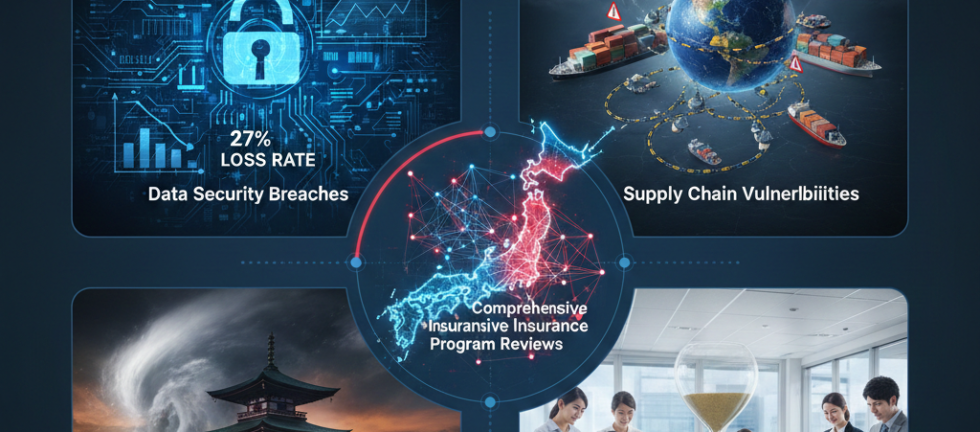
Data Security Breaches Emerge as Primary Corporate Concern Across Japan and Global Markets in Latest 2025 Research
Japanese corporations and institutions are undertaking comprehensive evaluations of their insurance portfolios as an increasingly complex array of digital security threats, supply network interruptions, and extreme climate incidents fundamentally transform the nation’s corporate risk environment, according to comprehensive findings released in Aon’s 2025 Global Risk Management Survey: Japan’s Evolving Risk Landscape.
The extensive 2025 Global Risk Management Survey conducted by Aon, which incorporates detailed country-specific analysis for Japan, revealed that digital security incidents and confidential information breaches have emerged as the paramount risk concern for organizations operating both internationally and specifically within the Japanese market. This finding underscores a dramatic shift in the corporate risk landscape over recent years, as digital transformation has accelerated across industries and threat actors have become increasingly sophisticated in their methods.
Within Japan’s business community, an alarming 27% of surveyed organizations acknowledged experiencing cyber-related financial losses during the reporting period. This substantial figure highlights the very real and present danger that digital threats pose to corporate financial stability and operational continuity. The percentage represents not merely potential vulnerabilities, but actual realized losses that have already impacted bottom lines, disrupted operations, and potentially compromised sensitive customer and corporate data.
Despite the widespread recognition of these digital dangers, the survey uncovered concerning disparities in organizational preparedness. While approximately 75.9% of Japanese organizations indicated they have implemented some form of mitigation processes to address cyber threats, only a mere 12.6% reported having comprehensive business continuity plans specifically designed to address cyber incidents. This dramatic gap between general awareness and detailed preparedness reveals critical vulnerabilities that could significantly influence insurance coverage adequacy and ultimately determine the success or failure of claims submissions when incidents occur.
Industry experts participating in the survey emphasized that this preparedness deficit has catalyzed increased organizational focus on cyber resilience strategies. Companies are now prioritizing the implementation of more robust technical security controls, developing comprehensive incident response protocols, and ensuring they maintain appropriate cyber insurance protection that accurately reflects their exposure levels. The recognition that cyber threats represent not just a technical challenge but a fundamental business risk has prompted C-suite executives to elevate digital security to a boardroom priority.
Organizations are simultaneously undertaking detailed reviews of their existing policy coverage limits and contractual terms to verify that these accurately mirror their current exposure levels. Many companies have discovered that policies purchased even two or three years ago may no longer provide adequate protection given the rapidly evolving threat landscape and the increasing sophistication of attack methodologies employed by cybercriminal organizations and state-sponsored threat actors.
Supply Chain Vulnerabilities Present Mounting Challenges for Import-Dependent Economy
Supply network disruption has established itself as another critical risk factor for Japanese enterprises, directly reflecting the nation’s substantial dependence on imported raw materials, energy resources, and manufactured components. Japan’s position as an island nation with limited natural resources has historically necessitated complex global supply relationships, and recent years have dramatically exposed the vulnerabilities inherent in these extended supply chains.
Escalating geopolitical tensions across multiple regions, persistent transportation delays affecting maritime and air cargo operations, and increasingly frequent severe weather events have collectively intensified corporate concerns regarding contingent business interruption scenarios and trade credit exposures. The compounding effect of these multiple risk factors has created a perfect storm of supply chain vulnerability that threatens operational continuity across numerous sectors.
According to Aon’s comprehensive research, Japanese companies are actively exploring strategies for supplier diversification and investigating alternative production locations to reduce concentration risk. This strategic reconsideration of supply chain architecture represents a fundamental shift from the just-in-time efficiency models that dominated Japanese manufacturing philosophy for decades. Organizations are now balancing efficiency against resilience, recognizing that redundancy and flexibility may prove more valuable than marginal cost savings in an increasingly volatile global environment.
Simultaneously, these organizations are conducting thorough reviews of their insurance coverage specifically addressing supply chain risks. Traditional property and business interruption policies may not adequately address the complex interdependencies that characterize modern global supply networks, prompting companies to seek specialized coverage options that better protect against contingent business interruption scenarios.
Natural Disaster Preparedness Remains Critical Priority in Earthquake-Prone Region
Weather-related incidents and natural catastrophes continue to represent a substantial concern for Japanese business operations across all sectors. The nation’s geographic position makes it particularly vulnerable to a wide range of natural hazards, and recent experience has demonstrated that these risks are intensifying rather than diminishing.
Frequent typhoons with increasing intensity, widespread flooding events affecting both urban and rural areas, and persistent earthquake activity continue to significantly impact manufacturing facilities, logistics infrastructure, and energy production and distribution operations. Japan’s position along the Pacific Ring of Fire ensures that seismic activity remains a constant consideration for facility planning and operational resilience strategies.
The research findings indicated that organizations throughout Japan are placing substantially greater emphasis on individual site resilience measures and multi-location insurance coverage arrangements designed to effectively manage potential losses resulting from large-scale catastrophic events or concurrent incidents affecting multiple facilities simultaneously. The recognition that traditional single-site coverage may prove inadequate when regional disasters affect entire supply chains or multiple corporate facilities has prompted a fundamental rethinking of property insurance strategies.
Companies are investing in physical infrastructure improvements, implementing enhanced emergency response protocols, and ensuring that insurance programs adequately address scenarios where multiple facilities or operations might be affected simultaneously by a single large-scale event or by correlated events occurring in close temporal proximity.
Workforce Challenges Create Additional Operational and Liability Exposures
Structural labor shortages and intensifying demand for workers with specialized technical skills are generating increased operational risks across Japanese industries. Japan’s demographic challenges, including an aging population and declining birthrate, have created persistent workforce availability concerns that affect virtually every economic sector.
In response to these workforce pressures, companies are making substantial investments in comprehensive upskilling programs and strategic reskilling initiatives designed to develop existing employees’ capabilities and adapt their skills to evolving operational requirements. These workforce development programs represent significant financial commitments but are increasingly viewed as essential for maintaining operational capability and competitive positioning.
Insurance providers are simultaneously conducting detailed assessments to understand how persistent workforce constraints might affect business interruption exposures and potential liability scenarios. The interconnection between workforce availability and operational continuity has become increasingly apparent, prompting underwriters to consider labor market dynamics as a material factor in risk assessment processes.
Comprehensive Insurance Program Reviews Become Strategic Imperative
The convergence of these multiple risk factors has prompted Japanese corporations to undertake broader, more comprehensive insurance program reviews designed to ensure that coverage arrangements accurately reflect the evolving risk landscape. These reviews extend beyond simple policy renewal processes to encompass fundamental reconsiderations of risk transfer strategies, coverage adequacy, and policy structure.
Organizations are examining their insurance programs through multiple lenses, including cyber security threats that continue to evolve in sophistication and impact, weather-related losses that appear to be increasing in both frequency and severity due to climate change dynamics, and supply chain disruption scenarios that have become more probable and potentially more severe given current geopolitical and economic conditions.
These comprehensive reviews often reveal coverage gaps that may have existed for years but only become apparent when viewed through the lens of current risk realities. Companies are discovering that insurance programs designed for previous risk environments may require substantial restructuring to address contemporary threats effectively.
The findings from Aon’s 2025 Global Risk Management Survey underscore a period of fundamental transition in Japan’s corporate risk landscape. Organizations that proactively address these evolving risks through comprehensive insurance program reviews, enhanced risk mitigation strategies, and robust business continuity planning will be best positioned to navigate the challenging environment ahead while protecting stakeholder value and maintaining operational resilience in the face of increasingly complex and interconnected threats.