
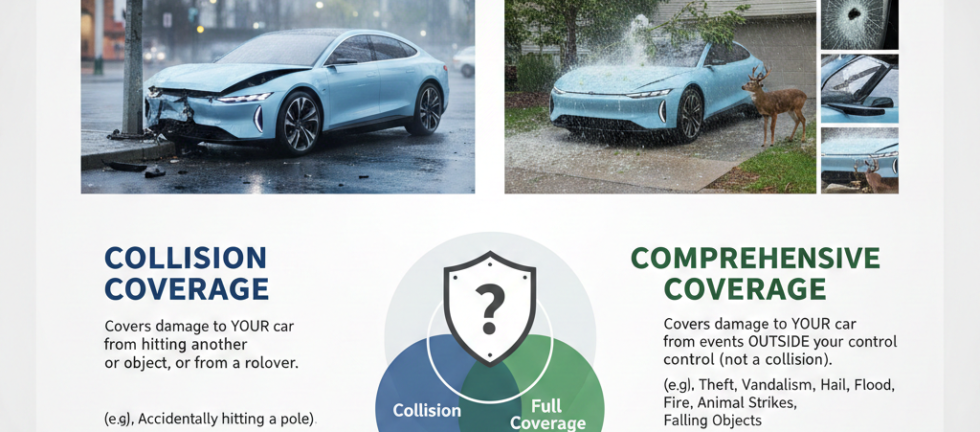
Auto insurance can feel overwhelming with all the terms and options, but two of the most important optional coverages comprehensive and collision often cause the most confusion. These two types protect your own vehicle (unlike liability, which covers damage or injuries you cause to others). They are frequently bundled together as part of “full coverage,” but they address completely different risks.
Understanding the differences helps you decide whether to carry both, one, or neither saving money without leaving yourself exposed to major financial hits. This guide explains what each covers, real-world examples, key factors in deciding what you need, and practical tips for 2026.
What Is Collision Coverage?
Collision insurance pays for repairs or replacement of your vehicle when it is damaged in a crash involving an impact whether with another vehicle, an object, or even in a single-vehicle accident.
It applies regardless of fault. If you’re at fault or the other driver is, collision covers your car’s damage (though if the other party is at fault and insured, their liability coverage may reimburse your insurer later through subrogation).
Common scenarios covered by collision insurance:
- Rear-ending another car at a stoplight.
- Hitting a guardrail, telephone pole, or fence.
- Sideswiping or being sideswiped by another vehicle.
- Single-car rollover or flipping.
- Crashing into a stationary object like a tree, mailbox, or building.
- Hitting a large pothole hard enough to cause structural damage (though some pothole claims may fall into gray areas depending on the policy and state).
Collision does not cover:
- Theft, vandalism, or fire.
- Weather-related damage like hail or floods.
- Animal strikes (these usually fall under comprehensive).
- Mechanical breakdowns or wear-and-tear issues.
Collision tends to be one of the more expensive optional coverages because accidents involving impacts are relatively common.
What Is Comprehensive Coverage?
Comprehensive insurance (sometimes called “other-than-collision” coverage) protects your vehicle from damage or loss caused by events outside of a typical crash. It covers “acts of God,” criminal acts, or unpredictable incidents.
Common scenarios covered by comprehensive insurance:
- Theft of the entire vehicle or parts.
- Vandalism (e.g., keying, broken windows, slashed tires).
- Fire or explosion damage.
- Hitting an animal (deer, elk, bird cracking the windshield deer strikes are one of the most frequent comprehensive claims).
- Weather events: hail dents, wind damage, falling tree branches, floods, hurricanes, tornadoes, or earthquakes.
- Falling objects (e.g., a rock from a truck, debris from construction).
- Contact with birds or other non-animal objects in rare cases.
Comprehensive does not cover:
- Damage from collisions (that’s collision coverage).
- Intentional damage you cause.
- Normal wear and tear, mechanical failures, or maintenance issues.
Comprehensive is usually much cheaper than collision—often a fraction of the cost—because non-collision events are less frequent for most drivers, though regional risks (like hail in certain states or deer in rural areas) can increase premiums.
Side-by-Side Comparison: Comprehensive vs. Collision
Here’s a clear breakdown of the key differences:
| Aspect | Collision Coverage | Comprehensive Coverage |
| Primary Purpose | Covers damage from impacts/crashes | Covers non-collision damage or loss |
| Fault Irrelevant? | Yes—covers your car regardless of fault | Yes—covers events mostly out of your control |
| Typical Examples | Rear-end collision, hitting a pole, rollover | Theft, hail, deer strike, vandalism, fire |
| Payout Basis | Actual cash value (ACV) minus deductible | Actual cash value (ACV) minus deductible |
| Average Annual Cost | Higher (often $500–$1,000+ depending on car, location, driving record) | Lower (often $100–$300) |
| Deductible Options | Usually $500–$2,000 | Usually $100–$1,000 (glass coverage often $0 deductible) |
| Required If… | Financed/leased vehicle (lender mandates) | Financed/leased vehicle (lender mandates) |
Both coverages pay up to your vehicle’s actual cash value (ACV) at the time of loss (market value, not what you paid or owe), minus your chosen deductible. If repairs exceed ACV, the car is declared a total loss, and you receive a payout check.
Do You Actually Need Both?
Neither comprehensive nor collision is required by state law (only liability is mandatory in most places), but lenders require both if your car is financed or leased to protect their investment.
If your vehicle is paid off, the decision comes down to personal risk tolerance, finances, and vehicle value.
Factors to Consider When Deciding:
- Vehicle Value vs. Premium Cost A common guideline: If your car’s ACV is less than about 10 times the annual premium for collision/comprehensive combined, it may not be worth keeping. Example: If premiums total $1,200/year and your car is worth $8,000, you’re essentially insuring something you could replace yourself. But if the car is worth $30,000+, the coverage is usually justified.
- Your Financial Situation Can you afford to repair or replace the car out-of-pocket if damaged? If not (or if it would strain your emergency fund), keep the coverages. Higher deductibles (e.g., $1,000 instead of $500) lower premiums significantly ideal if you have savings to cover the deductible.
- Risk Exposure
- High theft area? Keep comprehensive.
- Rural roads with lots of deer/wildlife? Comprehensive is valuable.
- Hail-prone region (e.g., parts of Texas, Colorado, Midwest)? Comprehensive often pays for itself in one storm.
- Urban commuting with heavy traffic? Collision is more critical due to higher crash risk.
- Dropping One but Not the Other Many drivers drop collision first on older cars (since crashes are more “controllable” with safe driving), but keep comprehensive for low-cost protection against theft, weather, or animals. Windshield replacement under comprehensive is often $0 deductible in many policies/states.
- Current Trends in 2026 With vehicle repair costs still elevated from supply chain issues and parts shortages lingering into the mid-2020s, keeping coverage on newer or mid-value cars makes more sense than in past years. Used car values have stabilized but remain higher than pre-2020 levels for many models.
When It Might Make Sense to Drop Collision and/or Comprehensive
- Your car is older (10+ years) or high-mileage with low market value.
- Premiums + deductible exceed 10–20% of the car’s worth over a few years.
- You have a large emergency fund and are a low-risk driver.
- You’re willing to self-insure minor or moderate damage.
Always get quotes before dropping premium savings can be substantial, but run the numbers carefully.
Bottom Line: Making the Smart Choice
Collision protects against the crashes that are statistically more likely (especially if you’re in traffic daily). Comprehensive guards against unpredictable, often regional risks that can be costly but less frequent.
For most people with newer, financed, or higher-value vehicles: Carry both as part of full coverage for peace of mind. For owners of older, paid-off cars: Evaluate annually many safely drop collision first, keep comprehensive if risks warrant it, or drop both if the math works.
Review your policy yearly, shop around for quotes, and adjust deductibles to fit your budget. Insurance isn’t one-size-fits-all; it’s about balancing protection with affordability based on your specific situation.
By knowing exactly what comprehensive vs. collision covers, you avoid overpaying for unnecessary coverage or risking big out-of-pocket expenses when the unexpected happens.