Mobile Phone Insurance Market Accelerates Past $70bn as Telecom Operators Dominate Sales
The global mobile phone insurance market is on a strong upward trajectory and is expected to exceed $70bn by 2029, driven by rising smartphone prices, increased device sophistication, and deeper involvement from telecom operators. According to a report by The Business Research Company, the Asia-Pacific region is set to record the fastest growth, supported by expanding smartphone penetration and a rapidly growing middle class.
Despite its rapid expansion, mobile phone insurance remains a relatively small slice of the broader insurance industry. Industry estimates suggest it represents around 2% of the projected $3.3tn global property and casualty insurance market by 2029. When viewed within the wider financial services sector—forecast to reach $47.6tn over the same period—mobile phone insurance accounts for just 0.1% of total market value. Still, its growth rate outpaces many traditional insurance segments.
Regional outlook: North America leads, Asia-Pacific accelerates
North America is expected to remain the largest market globally, with insurance premiums projected to climb from $12.4bn in 2024 to $20.2bn in 2029, reflecting a robust compound annual growth rate (CAGR) of about 10%. High smartphone replacement costs, mature insurance awareness, and well-established operator-led distribution models continue to support market dominance in the region.
Meanwhile, Asia-Pacific is emerging as the fastest-growing market, fueled by increasing adoption of premium smartphones, rapid urbanization, and growing consumer awareness of device protection. As smartphone prices rise across emerging economies, insurance is increasingly seen as a practical risk-management tool rather than an optional add-on.
Premium smartphones drive the bulk of demand
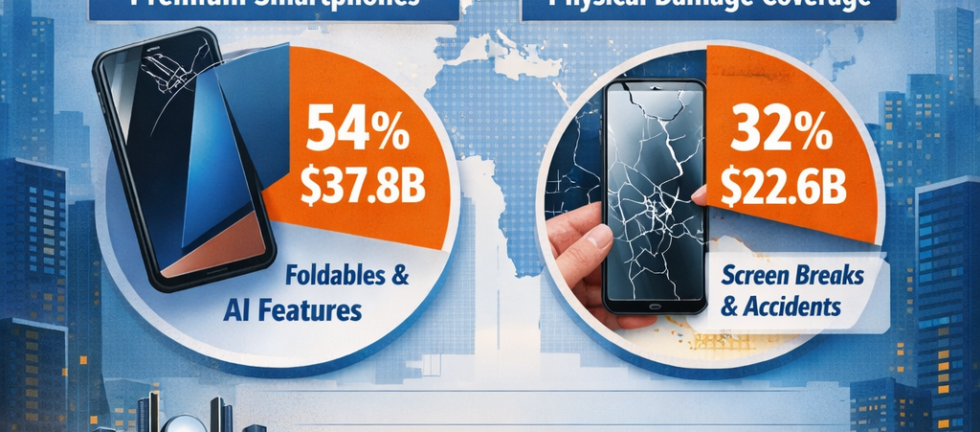
By handset category, premium smartphones are expected to dominate the market, accounting for approximately 54% of total premiums, or $37.8bn, by 2029. The surge in demand is closely tied to the escalating cost of flagship devices, the spread of advanced technologies such as foldable displays, AI-powered features, and high-end camera systems, and a growing willingness among consumers to protect expensive personal electronics.
As smartphones evolve into essential lifestyle and productivity tools, consumers are becoming less tolerant of out-of-pocket replacement costs, making insurance coverage more attractive.
Physical damage remains the core coverage segment
In terms of coverage type, physical damage protection is projected to be the largest segment, generating roughly $22.6bn, or 32% of total market value, by 2029. This growth reflects the high frequency of accidental damage—particularly screen breakage and drop-related incidents—as well as improved consumer understanding of the financial benefits of device protection plans.
The emphasis on physical damage also mirrors changes in device design, with larger screens and slimmer builds making modern smartphones more vulnerable to everyday accidents.
Telecom operators tighten control of distribution
Distribution dynamics are increasingly tilting in favor of mobile network operators, which are expected to generate around $23.3bn in premiums, representing 33% of the global market, by 2029. Telecom companies are leveraging their direct customer relationships by bundling insurance with handset financing, upgrade programs, and subscription plans, effectively embedding insurance into the smartphone purchase journey.
For insurers, partnerships with telecom operators offer access to vast customer bases and lower acquisition costs. For operators, insurance products provide an additional revenue stream and strengthen customer retention—making the relationship strategically attractive for both sides.